
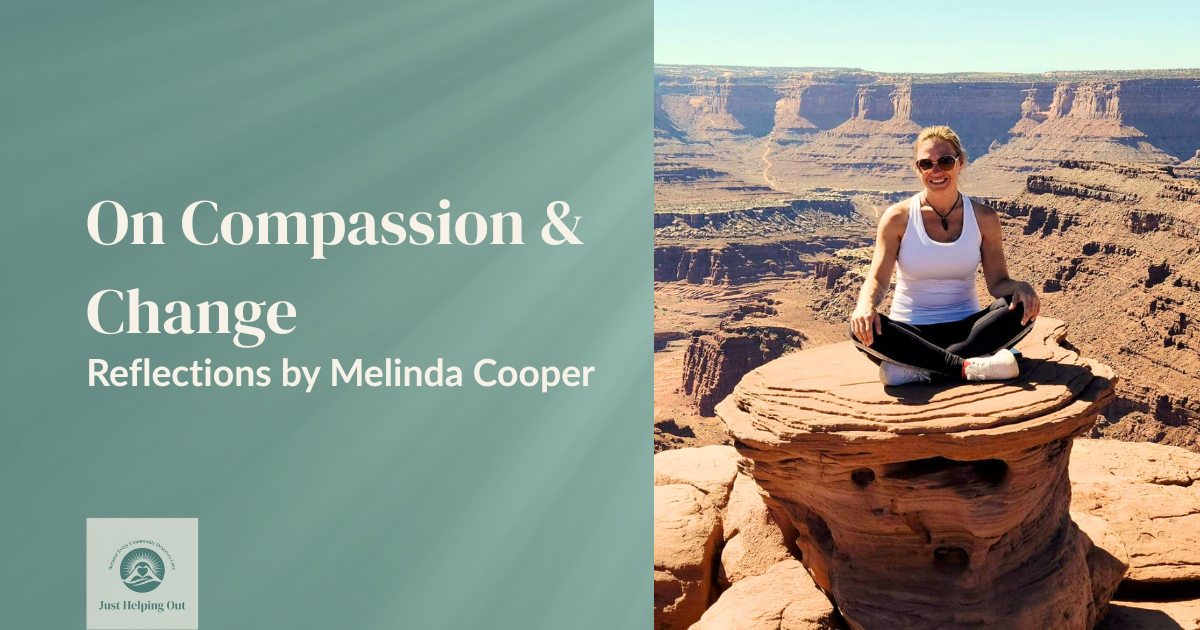
Building Without Burning Out
I’m learning that sustainable care begins with paying attention to how I actually feel day to day. This reflection explores building without urgency, performance, or burnout.
Reflections by Melinda Cooper
On Compassion and Change
For a long time, I believed that caring deeply meant pushing myself past my limits. That commitment looked like exhaustion. That urgency was proof I was doing something meaningful. Burnout wasn’t a warning sign; it was something I quietly accepted as the cost of showing up.
But as I began building something of my own, I realized I didn’t want to recreate that pattern.
I’m not interested in performative work.
I’m not interested in chasing approval or needing validation from others to confirm that what I’m building matters.
And I’m no longer willing to confuse constant output with purpose.
What I’m trying to build now requires something different from me.
It requires honesty.
“Care that costs us our health is not sustainable care.”
Sustainable care, I’m learning, begins with paying attention — not just to the work, but to myself. It asks me to notice how I’m actually feeling day to day, rather than how I think I should feel. It asks me to be realistic about what’s on my plate instead of pretending I can carry more than I can.
Some days, my energy is steady and clear.
Other days, it’s thin, fragile, or stretched.
Both are real.
Both deserve to be honored.
This kind of awareness can feel uncomfortable, especially in a culture that rewards overextension and praises those who never seem to slow down. But I’ve learned that ignoring my internal signals doesn’t make me stronger — it just disconnects me from myself.
Burnout didn’t come from caring too much.
It came from caring without boundaries.
From ignoring my own needs while tending to everything else.
Building without burning out means choosing to work at a pace I can actually live with. It means letting my capacity guide my commitments, rather than letting fear dictate my pace. It means trusting that rest, reflection, and adjustment are not signs of weakness, but signs of sustainability.
This doesn’t mean I care less.
If anything, it means I care more — more intentionally, more honestly, more humanly.
I want the work I build to last.
And for that to happen, I have to last too.
So I’m learning to check in with myself as carefully as I check in with the work. To listen when my body asks for rest. To adjust when something feels misaligned. To release the need to prove anything to anyone.
This is what sustainable care looks like for me now:
grounded, responsive, and rooted in self-trust.
Not rushed.
Not performative.
And not built at the expense of my own well-being.
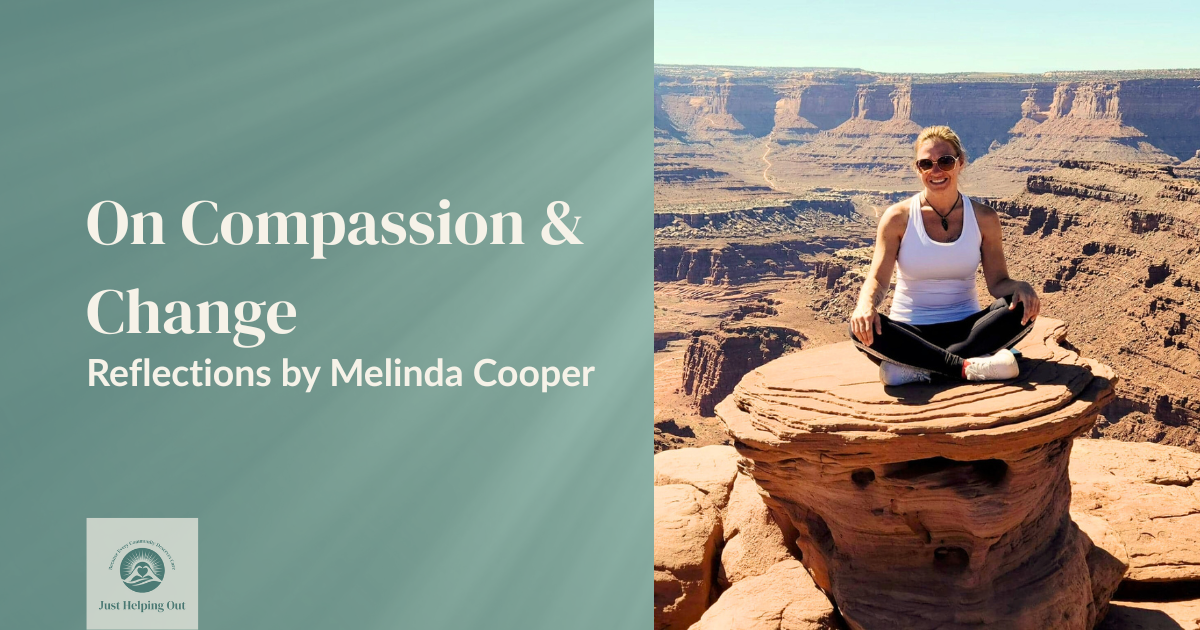
The Stillness Between Movements
The quiet moments between movements aren’t empty. They’re where clarity forms. This reflection explores how stillness helps us release urgency and move forward with alignment and ease.
Reflections by Melinda Cooper
On Compassion and Change
There is a quiet space that appears after a stretch of effort, a space where things become softer, slower, and strangely unfamiliar. It’s the pause between what I’ve released and what I’m becoming. For most of my life, these pauses made me uneasy. When everything slowed down, I felt like I was falling behind. Stillness felt like losing momentum, like I needed to hurry up and “fix it” before something slipped out of my hands.
But lately, I’ve begun to understand this space differently.
Stillness isn’t the absence of movement; it’s where new movement takes shape.
This season of my life has been full of building, creating, stretching, and letting go.
And now, the loudness has faded. What’s left is quiet. A gentle sort of quiet that asks more of my awareness than my energy. A quiet that draws me inward, back toward the steady center I lose when urgency takes over.
“Stillness isn’t stopping. It’s listening.”
The more I sit in this space, the more I realize how much of my old urgency wasn’t rooted in truth — it was born from fear. Fear of failing. Fear of being behind. Fear of not being enough. For years, my nervous system learned to equate slowness with danger, so the moment things paused, I scrambled to fill the silence with something productive.
Building this social enterprise has brought those patterns into full view.
Some days I still catch myself wanting to rush, to produce, to perform, to prove.
But urgency is no longer the guide I’m choosing to follow.
Stillness has become the teacher.
In the quiet, I notice the tension in my chest soften.
Ideas come more clearly, more naturally, without force.
Decisions feel less reactive and more intentional.
I trust myself more when I’m not in a rush.
Stillness gives me space to integrate, not just to act, but to become.
And in this becoming, I’m learning that transitions aren’t defined by the steps we take, but by the space between them. This is where inner clarity forms. This is where we regain our footing. This is where we can hear what actually matters.
This pause isn’t empty.
It’s full of direction, of wisdom, of quiet courage.
I’m learning to honor it instead of trying to outrun it.
When I move again, it won’t be out of fear of falling behind.
It won’t be because I’m chasing an outcome or performing for an invisible audience.
It will be because I’m ready; rooted, steady, and aligned.
Stillness isn’t a detour.
It’s a doorway.
And walking through it feels like coming home to myself.
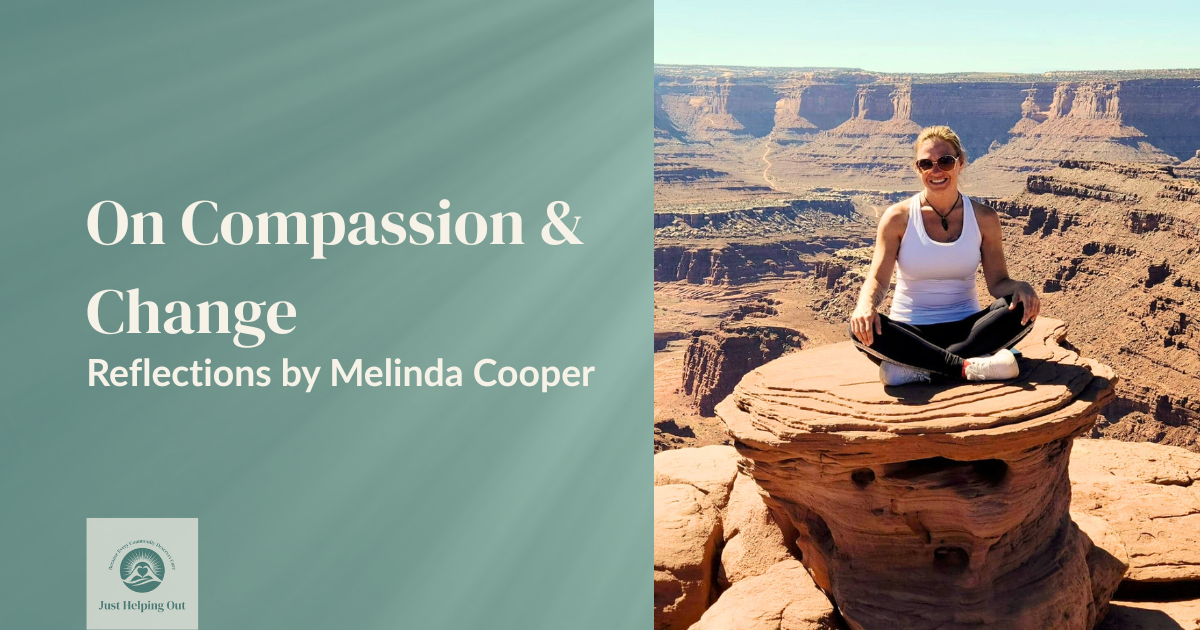
The Art of Letting Go (Without Giving Up)
Sometimes the hardest part of growth is slowing down. This reflection explores how releasing urgency opens space for clarity, courage, and change.
A reflection from the On Compassion and Change series
I didn’t realize how much urgency lived in my body until I started building this social enterprise.
Ever since early October, as I began creating Just Helping Out, I’ve felt these familiar waves rise up—moments where my chest tightens, my mind rushes ahead, and everything suddenly feels like it has to happen right now.
It’s an old feeling.
The kind that comes from places shaped by survival, performance, and the need to prove I belonged.
It took me a while to recognize it for what it was: not intuition, not clarity, but fear dressed up as urgency.
There have been moments when I’ve caught myself spiraling into self-doubt…
Moments where I questioned whether I was capable enough, prepared enough, or “legitimate” enough to build something meaningful from the ground up.
Moments where the fear of failing—or being seen failing—made my whole body move faster than my spirit could keep up.
And every time, it has taken reflection, thought redirection, grounding, and a kind of quiet re-centering to pull myself back into the present.
Self-awareness has become my anchor.
Noticing when my nervous system is slipping into fight-or-flight.
Noticing when the story I’m telling myself isn’t true.
Noticing when urgency is simply fear wearing a different face.
Because most of the time, nothing was actually wrong.
Nothing was collapsing.
Nothing was on fire.
I was just scared—and the old habits of rushing, performing, and pushing had come online to protect me in the only way they knew how.
“Urgency isn’t the same as importance.”
That realization changed everything.
I started sorting my thoughts differently:
Was something truly urgent, or was I just afraid?
Was I responding to reality, or to a story my fear was telling?
Was I moving with intention, or reacting to a feeling I didn’t yet understand?
Learning to pause in that tiny space between fear and action has become its own practice.
A breath.
A grounding.
A slow return to my body.
It’s in those moments that I remind myself: nothing meaningful is built from panic.
Care can’t be rushed.
Creativity can’t be forced.
And healing—whether personal or collective—can’t be scheduled into tidy timelines.
Letting go of urgency doesn’t mean letting go of passion or purpose.
It means moving differently.
It means choosing steadiness over speed.
It means trusting that you don’t have to outrun your fear in order to build something real.
And strangely, letting go has made me braver.
Because every time I set down urgency, I pick up presence.
Every time I set down perfection, I pick up possibility.
Every time I set down fear, I pick up clarity about why I’m doing this in the first place.
Letting go is not giving up.
It’s giving myself back to myself.
And maybe that’s the quiet wisdom of starting something later in life—
we finally learn that rushing doesn’t get us anywhere faster.
Presence does.
Patience does.
Trust does.
So I’m learning, slowly, gently, over and over again:
when urgency rises, I don’t have to follow it.
I can pause.
I can listen.
I can let go.
And I can keep going—
without giving up anything that matters.