
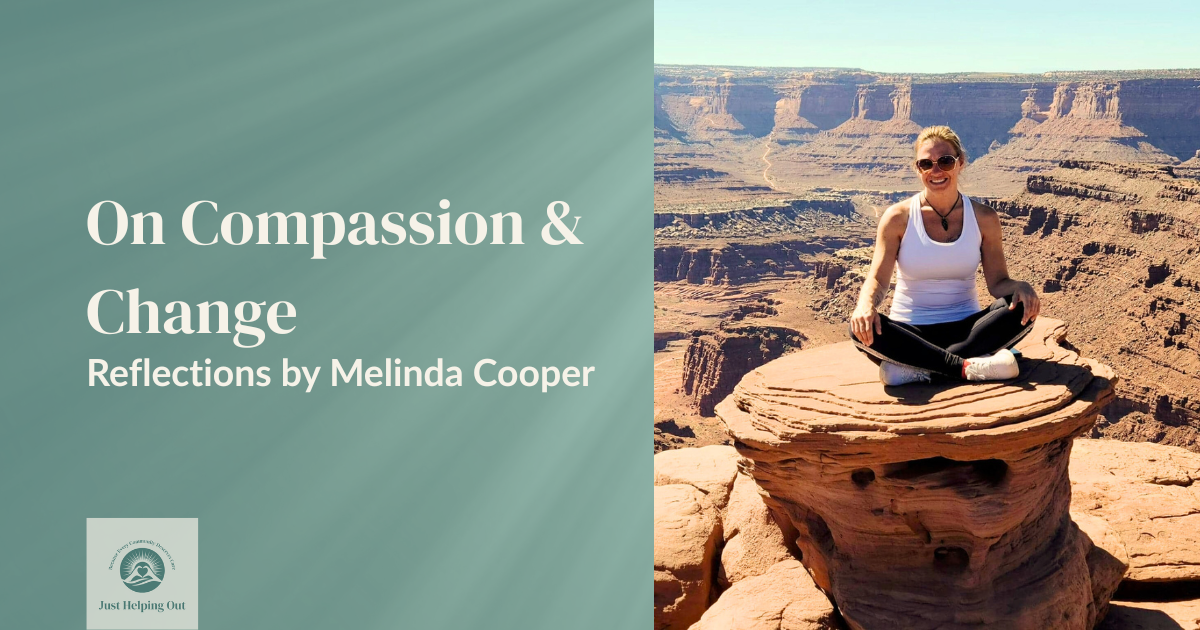
Compassion That Endures
Compassion is not just about showing up in moments of urgency. If care is going to save lives and preserve dignity, it has to be built in ways that can last.
Reflections by Melinda Cooper
On Compassion and Change
Compassion is often spoken about as a feeling, something we access in moments of empathy, grief, or urgency. But in the work of care, compassion must be more than a response. It has to be something that lasts.
In harm reduction and community care, the need is constant, while the support rarely is. Funding shifts. Policies change. Language becomes politicized. Entire programs can disappear overnight, not because the work stopped being effective, but because it became inconvenient or misunderstood.
And yet, the work continues. Because it has to.
This is where compassion moves beyond intention and into responsibility.
Care that endures requires structure. It requires redundancy. It requires support systems that do not collapse the moment one source is pulled away. When care is treated as something temporary, conditional, or supplemental, the people who rely on it are asked to live inside that instability.
That is not compassionate.
Harm reduction is evidence-based, data-backed, and life-saving. It reduces preventable death, connects people to resources, and restores dignity in environments that often deny it. But it exists within systems that push back against it, systems that demand proof while withholding support, and compliance while offering little protection.
“If compassion is the reason we show up, sustainability is how we stay.”
This is why nontraditional pathways of support matter. Not as replacements for systems change, but as safeguards while that change remains contested. Creative funding models, community-rooted partnerships, and shared responsibility are not indulgences. They are survival strategies.
Care cannot depend on a single door staying open.
When compassion is diversified, it becomes harder to erase. When it is shared across people, practices, and pathways, it becomes resilient. And resilience, in this context, is not about toughness; it is about continuity.
The goal is not endless output or sacrifice. The goal is to ensure the work continues, thoughtfully, ethically, and with care for the people doing it and the people receiving it.
Compassion that endures does not ask individuals to burn themselves out for the sake of the cause. It asks us to build the cause in a way that protects life, dignity, and longevity.
Because care that cannot last is not enough.
And compassion that endures is a collective responsibility.